In May 2025, tensions reemerged once again along the contested Cambodia–Thailand border near Preah Vihear temple, where a Cambodian soldier was killed during a military clash with Thai troops. What began as a deadly encounter evolved into an escalating confrontation involving artillery exchanges took place from July 24 to 28, 2025 – and, most notably, a leaked 17-minute phone call between Cambodia’s Senate President and former Prime Minister Hun Sen and Thailand’s suspended Prime Minister Paetongtarn Shinawatra. This call, in which the two former leaders discussed political turbulence and the border closure, quickly went viral after Hun Sen publicized it on social media, further stoking nationalist fervor on both sides.
While these developments reignited regional concerns about the fragile peace in mainland Southeast Asia, many commentaries have remained narrowly focused on Thailand’s domestic political instability or Hun Sen’s reputation as a political tactician. These interpretations are not without merit. However, they fail to fully account for the deeper symbolic logic that shapes the Cambodian regime’s response to external conflict: the ideological consolidation of “peace” as both a sacred achievement and a legitimizing narrative for authoritarian rule. In this light, the 2025 skirmish should not be seen as a separate discourse from Cambodia’s “peace at all costs” rhetoric but rather as a performance that paradoxically reinforces it.
Manufacturing Peace, Performing Power and Justice
At the heart of the Cambodian People’s Party (CPP)’s claim to legitimacy lies its carefully curated image as the guardian of peace. After more than three decades in power, former Prime Minister Hun Sen has sought to cement his legacy as the leader who brought Cambodia out of decades of civil war, culminating in the defeat and reintegration of the Khmer Rouge remnants in 1998 through his much-touted “win-win policy.” In the years since, this narrative has not only been enshrined in public monuments – most prominently the 54-meter-high Win-Win Monument unveiled in 2018 – but also embedded in public discourse through a ubiquitous slogan: “Thank you peace” (Arkun Santepheap).
Introduced formally in January 2020, the “Thank you peace” campaign calls upon Cambodians to appreciate the sacrifices that led to the nation’s stability and to remain vigilant in its defense. The slogan has since been plastered across ministries, hospitals, schools, and public billboards, becoming a daily mantra of political loyalty. It is a reminder that peace is not merely a historical event, but a present condition maintained by the CPP, and by extension, Hun Sen himself. As peace is turned into a commodity and a brand, dissent becomes not just politically dangerous but morally suspect.
This domestic mythology raises a critical question: if peace is such a foundational narrative for the CPP, why risk a conflict with Thailand that threatens to unravel it? Why would a country with limited military capability, economic dependency, and diplomatic vulnerability provoke a skirmish it can scarcely afford?
Conflict as Continuity
It is precisely this paradox that reveals the regime’s deeper political strategy. Rather than contradicting the peace narrative, the border clash with Thailand functions as an instrument to reassert and dramatize it. Peace, in this schema, is not merely the absence of war – it is a condition that must be perpetually defended. Conflict, when framed correctly, reinforces the myth of peace as a fragile and hard-won prize that only the ruling elite can secure.
In this sense, the 2025 conflict is a continuation, not a departure, from the regime’s ideological project. The “enemy at the gate” – whether it be domestic dissidents, foreign critics, or rival neighbors – becomes a rhetorical device to solidify internal unity. The border becomes both a geographical frontier and a symbolic line separating chaos from order, the past from the present, and, most critically, Hun Sen’s Cambodia from the one that came before.
This framing helps explain why Hun Sen’s decision to publicize the phone call with Paetongtarn Shinawatra was not a diplomatic faux past but a calculated strategy of irregular warfare. It externalized Cambodia’s grievances, redirected domestic anxieties toward a foreign adversary, and cast the Cambodian leadership as transparent and resolute in the face of foreign aggression. Even critics within Cambodia found it difficult to openly oppose the government’s handling of the crisis, lest they appear unpatriotic.
A Calculated Risk Amid Economic Headwinds
That said, the risks of confrontation were real and potentially costly – especially in economic terms. In April 2025, the Trump administration announced a 49% tariff on Cambodian exports to the United States, citing trade imbalances. This decision struck a major blow to Cambodia’s already fragile economy, particularly its textiles and apparel sector. Yet rather than retreat into isolationism in the global economy, the Cambodian government quickly initiated diplomatic negotiations with Washington D.C. The first round of trade talks was held in May in Washington, D.C., resulted in a gradual easing of the tariff – first down to 36%, and then to 19% as announced on August 1, 2025 – making Cambodia becoming a competitive trade partner like its regional neighbors.
Given these efforts to reduce economic pressure and rehabilitate ties with the United States, it would be politically and financially counterintuitive for Cambodia to instigate a war merely to distract from domestic challenges. Contrary to accusations by Thai commentators such as Thanachate Wisaijorn and former Ambassador Pisan Manawapat, the Cambodian government’s actions suggest a dual strategy: using conflict as a unifying nationalist spectacle while simultaneously pursuing pragmatic diplomacy to stabilize external relationships.
Nationalist Mobilization in the Social Media Age
What is especially noteworthy about the 2025 skirmish is how it catalyzed an emotional and symbolic response among younger Cambodians – many of whom were born after the war and raised in the relative stability of the post-Khmer Rouge era in the 1990s and 2000s. For this generation, the border conflict was a jolting reminder of the fragility of peace. The images of displaced civilians, wounded soldiers, and cratered landscapes went viral on Facebook, Instagram, TikTok, and X – sparking a wave of patriotic sentiment rarely seen in recent years.
Actors, influencers, and civil society groups joined the call to “stand with our troops,” organizing donation drives, posting messages of solidarity, and even boycotting Thai businesses. A Cambodian famous rapper, VannDa, arguably Cambodia’s most popular contemporary music artist, released a song title, “We Will Never Forget” on August 1, 2025, amassed over 350K views in less than 10 hours after its release. Some young entrepreneurs and content creators such as Pich Pisey pledged to shift their supply chains to local Cambodian producers. Others invoked history, recalling past struggles for territorial sovereignty, to amplify the stakes of the moment.
This groundswell of emotion, while partly organic, was also subtly orchestrated. Government-aligned media outlets and social media campaigns highlighted heroic narratives, emphasized unity, and framed criticism of the conflict as ungrateful to the sacrifices of those defending the nation. In doing so, the ruling CPP effectively turned a geopolitical crisis into a reaffirmation of national purpose – at least for the moment.
Policies and Patterns: State-Abetted Transnational Crime in Cambodia as a Global Security Threat គោលនយោបាយ និងលំនាំ៖ ឧក្រិដ្ឋកម្មឆ្លងដែនដែលប្រព្រឹត្តដោយរដ្ឋនៅកម្ពុជា ជាការគំរាមកំហែងសន្តិសុខសកល
Box 2. A Cautionary Note on Harm Minimization As one interviewee stated, “You only make sense of this when you start to look at Cambodia as a true mafia state.” They went on to suggest that, once this conceptual leap is made, observers must recognize that “all you can realistically do is to make it more difficult for them to be so brazen, to push them back into the shadows a bit.”
While the conclusions of this study overwhelmingly endorse this sentiment, an approach prioritizing “harm minimization” is neither a guaranteed victory nor without its own risks of collateral damage. These risks can be broadly viewed as falling within three categories. – First is the potential spillover impact on vulnerable Cambodians. FATF grey-listing in particular can be viewed as a form of broad-brush sanctioning which has a measured impact of a 7.6% decline in capital investment in listed countries.
While widespread capture of productive economic activities by the Cambodian elite ensures that the FATF’s punitive measure will impact its intended target, more marginal populations will also be impacted as access to global capital recedes. Concerned governments should be prepared to mobilize to offset spillover impacts as they reach Cambodian labor.
– Second, there is a noted apprehension in Western governments that Cambodia is drifting toward China and that an isolating “harm minimization” strategy might accelerate this trend. In general, interviewees objected to this logic. While almost all viewed it as objectively true that Cambodia largely now exists within China’s hegemonic orbit, few agreed that further cost imposition would meaningfully accelerate this trajectory. Several interviewees pointed to Cambodia’s irrevocable slide in that direction despite years of a mostly conciliatory Western approach. For instance, they highlighted the heavy focus of U.S. foreign policy towards Cambodia in recent years on the prevention/mediation of a China-funded Ream Naval Base. This effort–which seemingly sublimated all other U.S. foreign policy goals in the Kingdom–ultimately failed to prevent the feared outcome. Other interviewees disagreed altogether that the risks of modest further geopolitical alignment with Beijing could in any way outweigh the harms currently extending from the regime, which could be meaningfully stemmed by a coordinated harm minimization effort.
– The final and perhaps most existential risk to a harder international line on Cambodia is the one posed to a highly vulnerable local civil society and the vital resources they bring to bear in the effort to constrain the state-party’s portfolio of transnational and ecological crimes, as well as its abuses more broadly. This brings us to the study’s next key recommendation.
អ្វីគឺសិទ្ធិមនុស្ស? បដិវាទកម្ម ដំណោះស្រាយ និងជំហានទៅមុខ What is Human Rights? Controversies, Solution, and Future
សំគាល់៖ អ្នកចុះឈ្មោះចូលរួមនឹងទទួលបានសញ្ញាប័ត្រសំគាល់កំរិត១ ពីអង្គការដឺស៊ីរ៉ក់ Participants shall receive the Level 1 Participation Certificate from the CEROC
ពេលអ្នកសម្រេចបានសញ្ញាប័ត្រទាំង១០កំរិត អ្នកនឹងទទួលបានសញ្ញាប័ត្រថ្នាក់បញ្ចប់ឈ្មោះ ភាពជាអ្នកដឹកនាំឆ្នេីម ពីអង្គការដឺស៊ីរ៉ក់ When you completed all 10 levels, you shall receive the Gradute Certificate named “Outstanding Leadership Certificate” from the CEROC
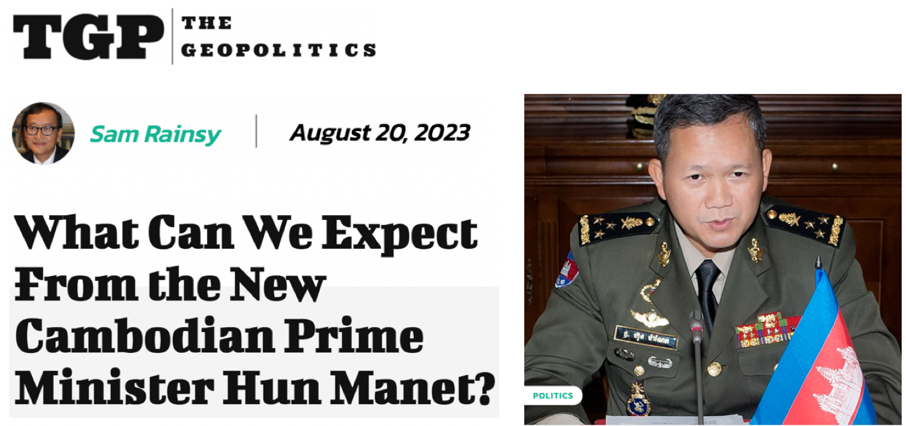
The Geopolitics August 20, 2023 What Can We Expect From the New Cambodian Prime Minister Hun Manet? By Sam Rainsy
Cambodia will have a new prime minister on August 22 in the person of Hun Manet, who will replace his father Hun Sen. This change has been orchestrated by Hun Sen himself after his 38-year rule, matching by only two African dictators.
Hun Manet’s assumption of office holds mostly symbolic value, as no significant changes in the political landscape of Cambodia are anticipated. In reality, Hun Sen will continue to pull the strings as the head of the Cambodian People’s Party (CPP), a party of communist origin that has been in power since 1979. Little will truly change as long as the current system established by Hun Sen himself remains intact. Hun Manet will effectively be a captive of this system, which he must preserve under the watchful eye of his father.
Neo-Khmer Rouge Regime
Hun Sen’s regime can be characterized as a neo-Khmer Rouge regime, as it is based on violence and impunity, much like under Pol Pot. Hun Sen was a loyal military leader under Pol Pot from 1975 to 1977. Under Hun Sen, at every level of the state, many new Cambodian leaders after Pol Pot were recruited from former Khmer Rouge cadres, allowing for the maintenance of a police state to this day.
What Hun Sen primarily expects from his son, Hun Manet, is the assurance of continued impunity. It’s widely known that in Phnom Penh, the courts are under political control, and none of the numerous political crimes – resembling acts of state terrorism – which have been committed under Hun Sen have ever been subject to a serious investigation. Cambodia is a land of impunity where the worst murderers roam freely within the corridors of state.
A glimmer of hope for an end to this impunity recently emerged from Paris. On 30 December, 2021, a French investigating judge’s ordinance hinted that Hun Sen could be prosecuted in France once he loses his judicial immunity tied to his role as head of government. This would be in relation to the grenade attack in Phnom Penh on 30 March, 1997. As a French citizen, I had filed a complaint against Hun Sen in the Paris court for an assassination attempt against me that resulted in at least 16 deaths among my supporters on that day.
Hun Sen’s second objective in passing the power from father to son is the ability to continue to control Cambodia both economically and in patrimonial terms.
The Cambodian economy is largely controlled by the Hun Sen family and its allies, forming a political and financial elite which holds immense wealth amidst widespread poverty. Hun Sen perpetuated the Khmer Rouge mentality and culture of considering the nation’s wealth and state property as spoils of war to be used at the victors’ discretion.
In this patrimonial power perspective, Hun Sen publicly declared that he saw himself in the future as “not only the father but also the grandfather of prime ministers.” He must have had the North Korean lineage of Kim Il-sung, Kim Jong-il and Kim Jong-un in mind.
Clan Succession
The replacement of Hun Sen by his son Hun Manet becomes almost comical when such succession extends not only to the Hun family but also to all families forming the ruling clan. In fact, practically all ministers in the current government led by Hun Sen will be replaced by their respective children in the upcoming government led by Hun Manet. This is a world-first that even North Korea had not dared to imagine.
What makes the creation of the Hun dynasty in Cambodia even more farcical is the “democratic” foundation that Hun Sen wanted to ensure for it. A two-penny farce that would be amusing if a country’s fate was not at stake.
Hun Sen wanted to take no risks over his son’s enthronement. On 23 July, he organized a sham election where his victory was 100% guaranteed. Just a few weeks before the voting day, he had arbitrarily removed the only opposition party that could have challenged him, the Candlelight Party (CP), which I founded 25 years ago.
This highly undemocratic and discriminatory measure provoked an outcry from the international community, which Hun Sen, in his determination to secure his son Hun Manet’s appointment as prime minister, utterly disregarded. But he won’t be able to ignore the backlash for long. Lack of legitimacy is the automatic result of elections without risk.
Lack of Legitimacy
This lack of legitimacy will remain a stain that forever marks the new government under Hun Manet.
Hun Manet himself has a lack of achievement for which Hun Sen cannot compensate. His personality seems rather dull compared to his father’s; he lacks charisma, eloquence and authority. Over the past twenty years spent alongside his father leading the country, particularly the military, he has never done or said anything that would suggest he possesses an independent personality. He has only continually praised his father without any critical thinking.
Despite being 45 years old, he has no known notable achievements or accomplishments, even though he had all the means to accomplish them. Just recently, when the time came to make him prime minister, slightly altering the initial timeline (see “What Lies Behind the Sudden Resignation of Prime Minister Hun Sen?” in The Geopolitics on August 7, 2023), “achievements” were suddenly attributed to him, such as his “heroic behavior” during border incidents with Thailand and Laos 10 or 15 years ago and his “exemplary leadership” in the fight against the Covid-19 pandemic.
These “achievements” largely rely on imagination, as some border incidents with neighboring countries were periodically manufactured by Hun Sen to boost his electoral campaigns, and the successes in fighting Covid-19 in Cambodia can raise skepticism (see “Cambodia is being turned into a political advert for Chinese vaccines” in The Geopolitics on November 16, 2021). Laos, which made little fuss about the pandemic, has fared better than Cambodia with fewer Covid-19 deaths per million inhabitants.
Even the highly-touted admission of Hun Manet to the US Military Academy at West Point conceals a secret inadvertently revealed by Hun Sen. In 2021, the father published a lengthy letter from his son in which the latter clarified that there were two paths to admission at West Point – one for Americans and the other for foreigners – and that he (Hun Manet) was admitted through the second path only thanks to political connections provided by the Phnom Penh government.
Looking ahead, with Hun Manet as prime minister and Hun Sen continuing to set the government’s major political directions, no liberalization of the current regime should be expected. This regime is fundamentally built on repression and violence, which have ensnared those exercising power. In fact, violence confines those who employ it to stay in power more so than those who suffer it. Any liberalization by dictators who rely on violence can only lead to their downfall. The enduring North Korean model is evidence of this.
Original source: https://thegeopolitics.com/what-can-we-expect-from-the-new-cambodian-prime-minister-hun-manet
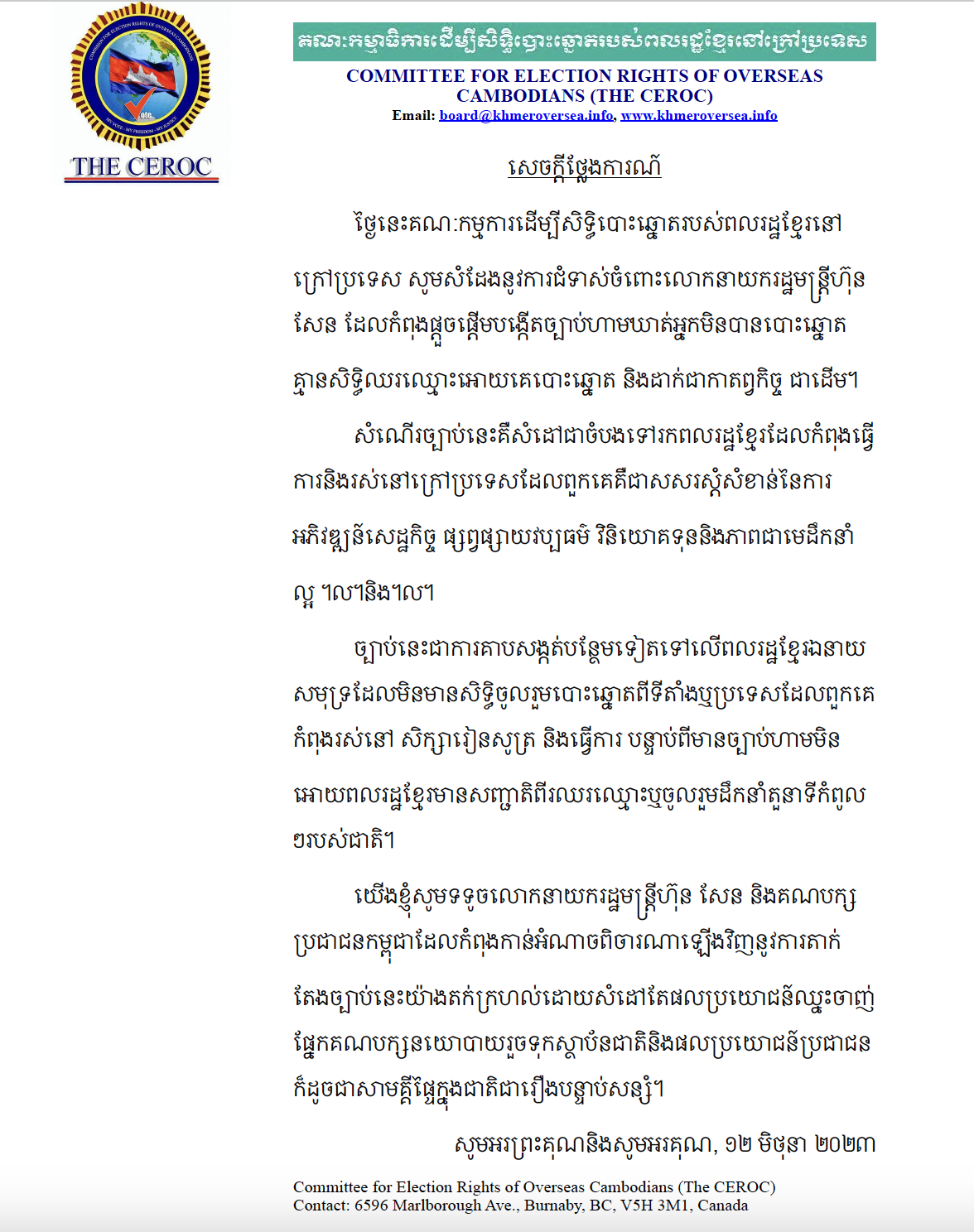
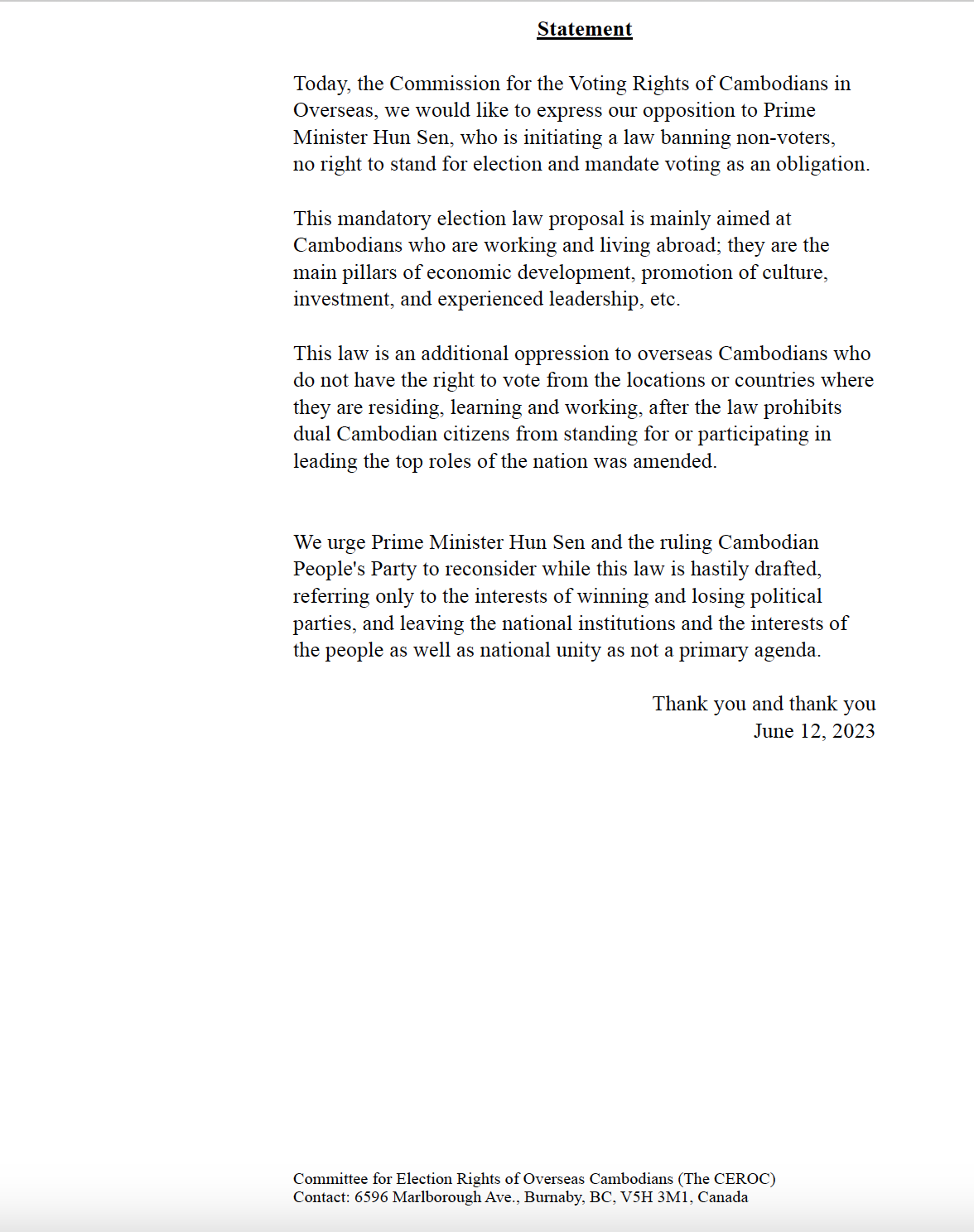
Today, the Commission for the Voting Rights of Cambodians in Overseas, we would like to express our opposition to Prime Minister Hun Sen, who is initiating a law banning non-voters, no right to stand for election and mandate voting as an obligation.
This mandatory election law proposal is mainly aimed at Cambodians who are working and living abroad; they are the main pillars of economic development, promotion of culture, investment, and experienced leadership, etc.
This law is an additional oppression to overseas Cambodians who do not have the right to vote from the locations or countries where they are residing, learning and working, after the law prohibits dual Cambodian citizens from standing for or participating in leading the top roles of the nation was amended.
We urge Prime Minister Hun Sen and the ruling Cambodian People’s Party to reconsider while this law is hastily drafted, referring only to the interests of winning and losing political parties, and leaving the national institutions and the interests of the people as well as national unity as not a primary agenda.