The Paris Agreements required the constituent assembly to produce a constitution that “shall declare that Cambodia will apply a liberal democracy, based on pluralism.” The term “liberal democracy” has been attributed to Prince Sihanouk, who had called for Cambodia to be a liberal democratic state during earlier negotiations. It seems likely that he used this term in the context of the negotiations because he assumed it was what the U.S. representatives and other key participants in the Paris Conference wanted to hear. The concept certainly does not reflect the principles of government he applied when he was king or prime minister in the 1950s, and questions remain regarding the adaptability of the Western political theory of liberalism to the conditions of a Buddhist, extremely poor, and agrarian society such as Cambodia. The Paris Agreements do not define the term, although they enumerate eight elements of an electoral process that the constitution must mention and that, presumably, are part of the definition of liberal democracy.
First, elections must take place regularly, which one can assume to mean that the terms of national assembly members must be limited and that members must either be re- elected or a new candidate elected to occupy a seat in the assembly after the term expires.
Second, elections must be “genuine,” presumably meaning that the process must be free of manipulation. This criterion is close to the concept of fairness in an election.
Third and fourth are the rights to vote and to be elected.
Fifth, sufrage must be universal.
Sixth, and closely related to universality, is the concept of equal sufrage, meaning that every vote has the same value. Equal and universal sufrage supposes nondiscrimination.
Seventh, ballots must be secret.
Finally, Annex 5 requires that the constitution provide for full and fair possibilities to organize in order to participate in the electoral process. This requirement relates to the formation and functioning of political parties, the essential feature of pluralism, and the possibility of conducting a campaign to attract voters.
The eight elements cover the formal aspects of what is understood by “liberal democracy, on the basis of pluralism.” The Paris Agreements properly dealt with all of the main post-conflict issues—ceasefire, repatriation, restored sovereignty and unity, transitional arrangements, and rehabilitation and reconstruction—except for the issue of responsibility for past abuses. The unwillingness to address the latter issue went so far as to exclude the word “genocide” from the text of the Paris Agreements, which referred instead to ensuring that “the policies and practices of the past shall never be allowed to return.” Moreover, none of the various drafts of the constitution referred to prosecutions or truth and reconciliation; they did not even mention the policies and practices of the past. The need to include the DK and China in the agreement and the Buddhist belief in reconciliation and love without retribution are strong arguments in favor of such silence, but impunity continues to be a major concern of Cambodian justice. Perhaps alienating the DK during the PICC was not an option and the Chinese vote was needed in the UN Security Council. But DK refusal to respect the Paris Agreements and continued violence would have justified a harder line at the time of the constitution’s drafting.
In any event, the product of the constitution-making process in 1993 was essentially a reversion to previous constitutions—combining elements of the 1947 and 1989 constitutions, with some liberalizing improvements—rather than a newly structured constitution built on Annex 5. This illustrates how Cambodian politics tended to outweigh the United Nations’ role as guarantor of the integrity of the Paris Agreements. Mixing the 1947 and 1989 constitutions, that is, combining the royalist electoral victors’ conception of stable government with CPP and State of Cambodia (SOC) habits as de facto government, makes sense in Cambodian politics.
However, the starting point of the agreements was an internationally agreed-upon definition of what was meant constitutionally by a liberal democracy on the basis of pluralism. UNTAC judged unwisely that it should respect Cambodian ways by allowing, first, the DK to behave contrary to the letter and the spirit of the agreements, and second, FUNCINPEC and the CPP to resolve a disputed election through pure politics. Its merits notwithstanding, the constitution was a victim of that politicization. One can argue that the constitution is better grounded in Cambodian culture than would have been the case if the United Nations had succeeded in making the parties comply strictly with the ideas of constitutionalism agreed to in Paris, or provided more guidance on constitution making beyond the guidelines for an electoral process that were contained in the Paris Agreements. However, restoring politics as usual allowed for much political violence, extreme delays in creating the Supreme Council of the Magistracy, continued impunity for the DK and other politically protected perpetrators of abuse, restrictions on press freedoms, and the lack of an independent judiciary. These problems would not have been eliminated merely by adopting a constitution that met the overly optimistic claim of Chem Sngoun, former minister of justice, who died in 1999, that it was “neither monarchical, nor republican, but a democratic constitution.” But a constitution-making process and constitution that were closer to what was achieved in South Africa might have encouraged less brute politics and more democracy.
In May 2025, tensions reemerged once again along the contested Cambodia–Thailand border near Preah Vihear temple, where a Cambodian soldier was killed during a military clash with Thai troops. What began as a deadly encounter evolved into an escalating confrontation involving artillery exchanges took place from July 24 to 28, 2025 – and, most notably, a leaked 17-minute phone call between Cambodia’s Senate President and former Prime Minister Hun Sen and Thailand’s suspended Prime Minister Paetongtarn Shinawatra. This call, in which the two former leaders discussed political turbulence and the border closure, quickly went viral after Hun Sen publicized it on social media, further stoking nationalist fervor on both sides.
While these developments reignited regional concerns about the fragile peace in mainland Southeast Asia, many commentaries have remained narrowly focused on Thailand’s domestic political instability or Hun Sen’s reputation as a political tactician. These interpretations are not without merit. However, they fail to fully account for the deeper symbolic logic that shapes the Cambodian regime’s response to external conflict: the ideological consolidation of “peace” as both a sacred achievement and a legitimizing narrative for authoritarian rule. In this light, the 2025 skirmish should not be seen as a separate discourse from Cambodia’s “peace at all costs” rhetoric but rather as a performance that paradoxically reinforces it.
Manufacturing Peace, Performing Power and Justice
At the heart of the Cambodian People’s Party (CPP)’s claim to legitimacy lies its carefully curated image as the guardian of peace. After more than three decades in power, former Prime Minister Hun Sen has sought to cement his legacy as the leader who brought Cambodia out of decades of civil war, culminating in the defeat and reintegration of the Khmer Rouge remnants in 1998 through his much-touted “win-win policy.” In the years since, this narrative has not only been enshrined in public monuments – most prominently the 54-meter-high Win-Win Monument unveiled in 2018 – but also embedded in public discourse through a ubiquitous slogan: “Thank you peace” (Arkun Santepheap).
Introduced formally in January 2020, the “Thank you peace” campaign calls upon Cambodians to appreciate the sacrifices that led to the nation’s stability and to remain vigilant in its defense. The slogan has since been plastered across ministries, hospitals, schools, and public billboards, becoming a daily mantra of political loyalty. It is a reminder that peace is not merely a historical event, but a present condition maintained by the CPP, and by extension, Hun Sen himself. As peace is turned into a commodity and a brand, dissent becomes not just politically dangerous but morally suspect.
This domestic mythology raises a critical question: if peace is such a foundational narrative for the CPP, why risk a conflict with Thailand that threatens to unravel it? Why would a country with limited military capability, economic dependency, and diplomatic vulnerability provoke a skirmish it can scarcely afford?
Conflict as Continuity
It is precisely this paradox that reveals the regime’s deeper political strategy. Rather than contradicting the peace narrative, the border clash with Thailand functions as an instrument to reassert and dramatize it. Peace, in this schema, is not merely the absence of war – it is a condition that must be perpetually defended. Conflict, when framed correctly, reinforces the myth of peace as a fragile and hard-won prize that only the ruling elite can secure.
In this sense, the 2025 conflict is a continuation, not a departure, from the regime’s ideological project. The “enemy at the gate” – whether it be domestic dissidents, foreign critics, or rival neighbors – becomes a rhetorical device to solidify internal unity. The border becomes both a geographical frontier and a symbolic line separating chaos from order, the past from the present, and, most critically, Hun Sen’s Cambodia from the one that came before.
This framing helps explain why Hun Sen’s decision to publicize the phone call with Paetongtarn Shinawatra was not a diplomatic faux past but a calculated strategy of irregular warfare. It externalized Cambodia’s grievances, redirected domestic anxieties toward a foreign adversary, and cast the Cambodian leadership as transparent and resolute in the face of foreign aggression. Even critics within Cambodia found it difficult to openly oppose the government’s handling of the crisis, lest they appear unpatriotic.
A Calculated Risk Amid Economic Headwinds
That said, the risks of confrontation were real and potentially costly – especially in economic terms. In April 2025, the Trump administration announced a 49% tariff on Cambodian exports to the United States, citing trade imbalances. This decision struck a major blow to Cambodia’s already fragile economy, particularly its textiles and apparel sector. Yet rather than retreat into isolationism in the global economy, the Cambodian government quickly initiated diplomatic negotiations with Washington D.C. The first round of trade talks was held in May in Washington, D.C., resulted in a gradual easing of the tariff – first down to 36%, and then to 19% as announced on August 1, 2025 – making Cambodia becoming a competitive trade partner like its regional neighbors.
Given these efforts to reduce economic pressure and rehabilitate ties with the United States, it would be politically and financially counterintuitive for Cambodia to instigate a war merely to distract from domestic challenges. Contrary to accusations by Thai commentators such as Thanachate Wisaijorn and former Ambassador Pisan Manawapat, the Cambodian government’s actions suggest a dual strategy: using conflict as a unifying nationalist spectacle while simultaneously pursuing pragmatic diplomacy to stabilize external relationships.
Nationalist Mobilization in the Social Media Age
What is especially noteworthy about the 2025 skirmish is how it catalyzed an emotional and symbolic response among younger Cambodians – many of whom were born after the war and raised in the relative stability of the post-Khmer Rouge era in the 1990s and 2000s. For this generation, the border conflict was a jolting reminder of the fragility of peace. The images of displaced civilians, wounded soldiers, and cratered landscapes went viral on Facebook, Instagram, TikTok, and X – sparking a wave of patriotic sentiment rarely seen in recent years.
Actors, influencers, and civil society groups joined the call to “stand with our troops,” organizing donation drives, posting messages of solidarity, and even boycotting Thai businesses. A Cambodian famous rapper, VannDa, arguably Cambodia’s most popular contemporary music artist, released a song title, “We Will Never Forget” on August 1, 2025, amassed over 350K views in less than 10 hours after its release. Some young entrepreneurs and content creators such as Pich Pisey pledged to shift their supply chains to local Cambodian producers. Others invoked history, recalling past struggles for territorial sovereignty, to amplify the stakes of the moment.
This groundswell of emotion, while partly organic, was also subtly orchestrated. Government-aligned media outlets and social media campaigns highlighted heroic narratives, emphasized unity, and framed criticism of the conflict as ungrateful to the sacrifices of those defending the nation. In doing so, the ruling CPP effectively turned a geopolitical crisis into a reaffirmation of national purpose – at least for the moment.
អ្វីគឺសិទ្ធិមនុស្ស? បដិវាទកម្ម ដំណោះស្រាយ និងជំហានទៅមុខ What is Human Rights? Controversies, Solution, and Future
សំគាល់៖ អ្នកចុះឈ្មោះចូលរួមនឹងទទួលបានសញ្ញាប័ត្រសំគាល់កំរិត១ ពីអង្គការដឺស៊ីរ៉ក់ Participants shall receive the Level 1 Participation Certificate from the CEROC
ពេលអ្នកសម្រេចបានសញ្ញាប័ត្រទាំង១០កំរិត អ្នកនឹងទទួលបានសញ្ញាប័ត្រថ្នាក់បញ្ចប់ឈ្មោះ ភាពជាអ្នកដឹកនាំឆ្នេីម ពីអង្គការដឺស៊ីរ៉ក់ When you completed all 10 levels, you shall receive the Gradute Certificate named “Outstanding Leadership Certificate” from the CEROC
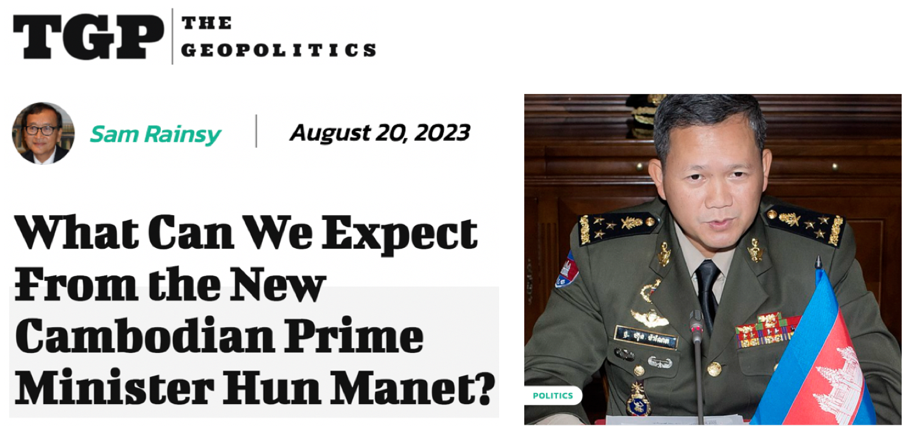
The Geopolitics August 20, 2023 What Can We Expect From the New Cambodian Prime Minister Hun Manet? By Sam Rainsy
Cambodia will have a new prime minister on August 22 in the person of Hun Manet, who will replace his father Hun Sen. This change has been orchestrated by Hun Sen himself after his 38-year rule, matching by only two African dictators.
Hun Manet’s assumption of office holds mostly symbolic value, as no significant changes in the political landscape of Cambodia are anticipated. In reality, Hun Sen will continue to pull the strings as the head of the Cambodian People’s Party (CPP), a party of communist origin that has been in power since 1979. Little will truly change as long as the current system established by Hun Sen himself remains intact. Hun Manet will effectively be a captive of this system, which he must preserve under the watchful eye of his father.
Neo-Khmer Rouge Regime
Hun Sen’s regime can be characterized as a neo-Khmer Rouge regime, as it is based on violence and impunity, much like under Pol Pot. Hun Sen was a loyal military leader under Pol Pot from 1975 to 1977. Under Hun Sen, at every level of the state, many new Cambodian leaders after Pol Pot were recruited from former Khmer Rouge cadres, allowing for the maintenance of a police state to this day.
What Hun Sen primarily expects from his son, Hun Manet, is the assurance of continued impunity. It’s widely known that in Phnom Penh, the courts are under political control, and none of the numerous political crimes – resembling acts of state terrorism – which have been committed under Hun Sen have ever been subject to a serious investigation. Cambodia is a land of impunity where the worst murderers roam freely within the corridors of state.
A glimmer of hope for an end to this impunity recently emerged from Paris. On 30 December, 2021, a French investigating judge’s ordinance hinted that Hun Sen could be prosecuted in France once he loses his judicial immunity tied to his role as head of government. This would be in relation to the grenade attack in Phnom Penh on 30 March, 1997. As a French citizen, I had filed a complaint against Hun Sen in the Paris court for an assassination attempt against me that resulted in at least 16 deaths among my supporters on that day.
Hun Sen’s second objective in passing the power from father to son is the ability to continue to control Cambodia both economically and in patrimonial terms.
The Cambodian economy is largely controlled by the Hun Sen family and its allies, forming a political and financial elite which holds immense wealth amidst widespread poverty. Hun Sen perpetuated the Khmer Rouge mentality and culture of considering the nation’s wealth and state property as spoils of war to be used at the victors’ discretion.
In this patrimonial power perspective, Hun Sen publicly declared that he saw himself in the future as “not only the father but also the grandfather of prime ministers.” He must have had the North Korean lineage of Kim Il-sung, Kim Jong-il and Kim Jong-un in mind.
Clan Succession
The replacement of Hun Sen by his son Hun Manet becomes almost comical when such succession extends not only to the Hun family but also to all families forming the ruling clan. In fact, practically all ministers in the current government led by Hun Sen will be replaced by their respective children in the upcoming government led by Hun Manet. This is a world-first that even North Korea had not dared to imagine.
What makes the creation of the Hun dynasty in Cambodia even more farcical is the “democratic” foundation that Hun Sen wanted to ensure for it. A two-penny farce that would be amusing if a country’s fate was not at stake.
Hun Sen wanted to take no risks over his son’s enthronement. On 23 July, he organized a sham election where his victory was 100% guaranteed. Just a few weeks before the voting day, he had arbitrarily removed the only opposition party that could have challenged him, the Candlelight Party (CP), which I founded 25 years ago.
This highly undemocratic and discriminatory measure provoked an outcry from the international community, which Hun Sen, in his determination to secure his son Hun Manet’s appointment as prime minister, utterly disregarded. But he won’t be able to ignore the backlash for long. Lack of legitimacy is the automatic result of elections without risk.
Lack of Legitimacy
This lack of legitimacy will remain a stain that forever marks the new government under Hun Manet.
Hun Manet himself has a lack of achievement for which Hun Sen cannot compensate. His personality seems rather dull compared to his father’s; he lacks charisma, eloquence and authority. Over the past twenty years spent alongside his father leading the country, particularly the military, he has never done or said anything that would suggest he possesses an independent personality. He has only continually praised his father without any critical thinking.
Despite being 45 years old, he has no known notable achievements or accomplishments, even though he had all the means to accomplish them. Just recently, when the time came to make him prime minister, slightly altering the initial timeline (see “What Lies Behind the Sudden Resignation of Prime Minister Hun Sen?” in The Geopolitics on August 7, 2023), “achievements” were suddenly attributed to him, such as his “heroic behavior” during border incidents with Thailand and Laos 10 or 15 years ago and his “exemplary leadership” in the fight against the Covid-19 pandemic.
These “achievements” largely rely on imagination, as some border incidents with neighboring countries were periodically manufactured by Hun Sen to boost his electoral campaigns, and the successes in fighting Covid-19 in Cambodia can raise skepticism (see “Cambodia is being turned into a political advert for Chinese vaccines” in The Geopolitics on November 16, 2021). Laos, which made little fuss about the pandemic, has fared better than Cambodia with fewer Covid-19 deaths per million inhabitants.
Even the highly-touted admission of Hun Manet to the US Military Academy at West Point conceals a secret inadvertently revealed by Hun Sen. In 2021, the father published a lengthy letter from his son in which the latter clarified that there were two paths to admission at West Point – one for Americans and the other for foreigners – and that he (Hun Manet) was admitted through the second path only thanks to political connections provided by the Phnom Penh government.
Looking ahead, with Hun Manet as prime minister and Hun Sen continuing to set the government’s major political directions, no liberalization of the current regime should be expected. This regime is fundamentally built on repression and violence, which have ensnared those exercising power. In fact, violence confines those who employ it to stay in power more so than those who suffer it. Any liberalization by dictators who rely on violence can only lead to their downfall. The enduring North Korean model is evidence of this.
Original source: https://thegeopolitics.com/what-can-we-expect-from-the-new-cambodian-prime-minister-hun-manet
CAMBODIAN-AMERICAN POLITICAL PRISONER THEARY SENG BEGINS ONE-WEEK HUNGER STRIKE
Seng demands transfer to Phnom Penh prison and same rights as other prisoners, including access to Church services and phone calls
PREAH VIHEAR PRISON, CAMBODIA – Today, Theary Seng began a one-week hunger strike in the rural Preah Vihear Prison – where she was clandestinely sent a six-hour drive from Phnom Penh to keep her far away from her family, counsel, and supporters. Theary is calling upon authorities to transfer her immediately back to Prey Sar Prison in Phnom Penh. She is also demanding the same rights that other prisoners have but she has been repeatedly denied, including having weekly access to Church services and the ability to regularly make phone calls. Theary has been detained since June 14, 2022, following a sham mass trial that received an “F” grade from the Clooney Foundation for Justice’s TrialWatch Initiative. She was convicted and sentenced to six years in prison for “conspiracy to commit treason” and “incitement to create gross chaos impacting public security” alongside dozens of other activists and political opposition leaders.
Theary’s parents were murdered by the Khmer Rouge and she was imprisoned in Cambodia as a young child. She escaped and fled to the U.S., where she obtained her bachelors’ and law degrees, before returning to Cambodia in 2004 to found two NGOs aimed at human rights and civic engagement.
Kerry Kennedy, President of Robert F. Kennedy Human Rights, remarked “I met Theary in 2009, when she became lead educator for RFK Human Rights’ education program across Cambodia. She was deeply respected for her commitment to ending impunity, for holding dictator Hun Sen to account, and for courageously speaking truth to power. In retaliation, she lived under constant threat but was never been silent.” Jared Genser, Managing Director of Perseus Strategies, added “Theary’s courage, grace, and dignity in standing up to Hun Sen are an inspiration to her people.” And Margaux Ewen, Director of the Freedom House Political Prisoners Initiative, said: “Theary was convicted under provisions of the Cambodian Criminal Code that are routinely weaponized against human rights and democracy activists.”
Shortly after her conviction, State Department Spokesperson Ned Price noted, “All Cambodians should be able to exercise their human rights” and called upon Cambodian authorities to release “all those unjustly detained, including Theary Seng.” Likewise, Under Secretary of State Uzra Zeya, USAID Administrator Samantha Power, and Ambassador W. Patrick Murphy all urged Theary’s immediate and unconditional release. Later, Secretary of State Anthony Blinken pressed Hun Sen in person in Phnom Penh on August 4 to release Theary and all activists detained on politically motivated charges.
From November 12-14, President Biden will attend the U.S.-ASEAN Summit and visit Phnom Penh, where he is expected to meet with Prime Minister Hun Sen. Theary’s international team calls upon the President to press Hun Sen for Theary’s freedom – and freedom for all the political prisoners of Cambodia.
Perseus Strategies and RFK Human Rights serve as pro bono counsel to Theary Seng. Freedom House is also providing her with support.